
What Happened in Boston at NACBA 2026, the Consumer Rights Champion Award, and Voices of Consumer Rights
Every April, something happens that most people outside the legal profession never hear about. Bankruptcy attorneys from across the country gather in one city. They compare notes, attend sessions, hear from judges and trustees and policy advocates, and remind each other why they chose a field of law that rarely makes the highlight reel.
In 2026, that city was Boston. And for Adrienne Hines, founder of The Lady Like Lawyer, this particular convention was unlike any before it.
NACBA: The Organization Most People Have Never Heard Of
The National Association of Consumer Bankruptcy Attorneys (NACBA) is the only national professional organization in the country devoted exclusively to consumer bankruptcy practice. Most bar associations represent attorneys broadly, across every area of law. NACBA represents the lawyers who stand specifically on the consumer side of the financial system: the attorneys whose clients are individuals and families, not banks, hedge funds, or corporate creditors.
It is a relatively small professional community. Most NACBA members are solo practitioners or work in small firms. They sit across from people in some of the most vulnerable moments of their lives. They translate complicated federal law into something that can give clients their footing back. And once a year, they gather.
This year's keynote was delivered by Richard Dubois, Executive Director of the National Consumer Law Center. the leading national voice on consumer protection law and policy.
The 2026 Consumer Rights Champion Award
At the convention, NACBA named Adrienne Hines their 2026 Consumer Rights Champion.
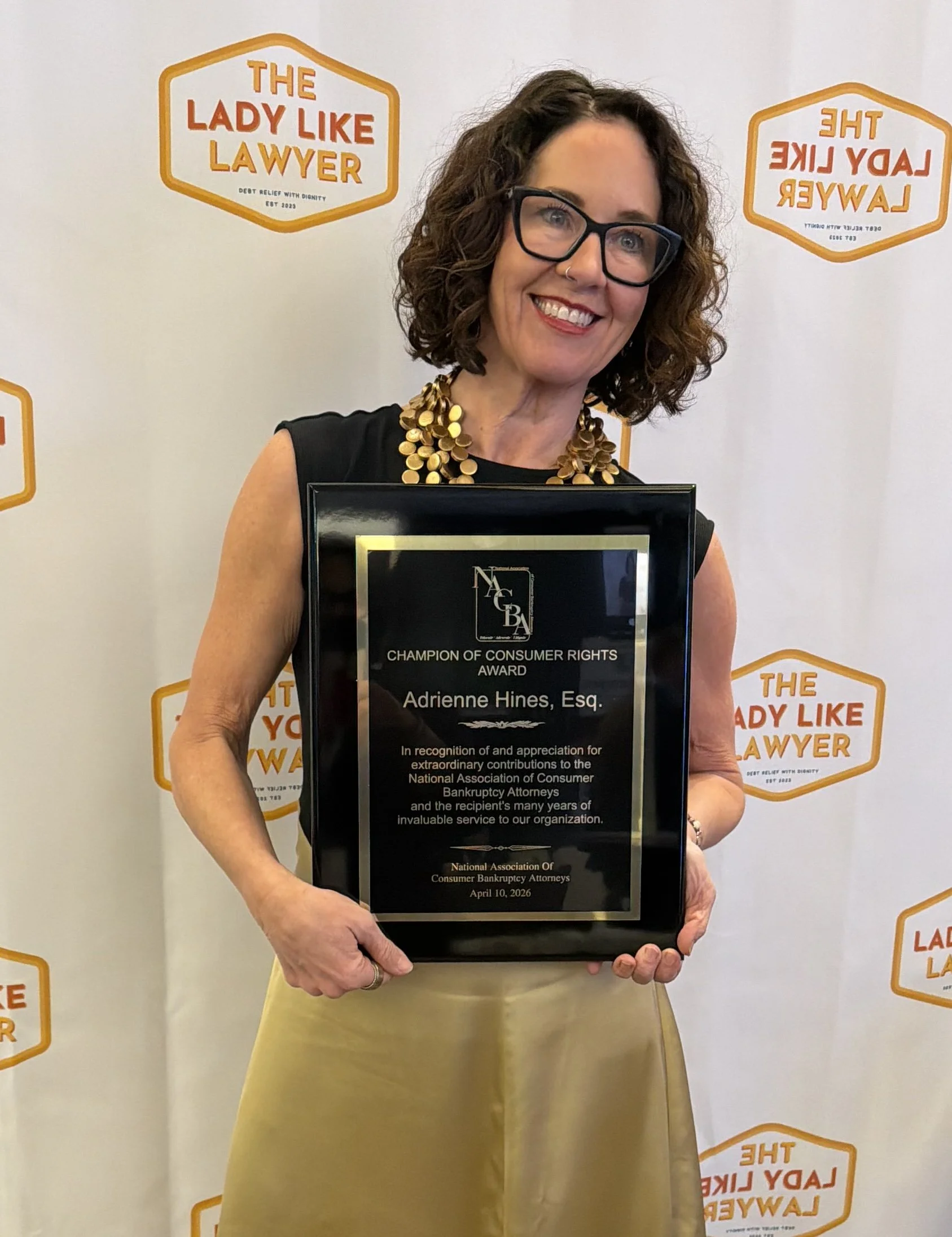
The Consumer Rights Champion Award recognizes attorneys whose work on behalf of consumers extends beyond their individual practices through public education, advocacy, content creation, or systemic work that benefits people who may never set foot in their offices. Two other attorneys received the same recognition: Chad Van Horn and Tecla Druffel.
Tecla Druffel, an attorney in Idaho, came to find Adrienne after the ceremony. She is currently fighting to remove a Chapter 13 trustee in her district; an attorney who has been quietly making life harder for debtors for years and her brief on the matter is, by all accounts, exactly the kind of systemic advocacy the award was designed to recognize. That conversation was one of the most meaningful of the entire trip.
The Lady Like Lawyer Comes to Boston
The convention wasn't just a professional milestone. It was also an opportunity to bring The Lady Like Lawyer into the room with her professional peers in a visible, tangible way.
Adrienne had a booth at the convention and it was not a folding table with a stack of business cards. It featured a step-and-repeat backdrop with mirrored Lady Like Lawyer branding, professional lighting, a microphone and interview setup, and copies of her book Bankruptcy Magic available for attendees. Hundreds of signed copies were given away to colleagues throughout the week.
The booth became a gathering point. Attorneys from every corner of the country stopped to talk; some whose names Adrienne had known from briefs and Zoom hearings, finally meeting in person. Some had been quietly following her content for years and introduced themselves for the first time. Jenny Doling, a colleague she had never previously met, became a real friend over the course of the convention. Alexander Berry-Santoro, who had just received his own NACBA recognition, sat down for one of the most thoughtful conversations of the week. And Tara Salinas (the person responsible for nominating Adrienne for the Consumer Rights Champion award in the first place) was there.
The interviews recorded at that booth will be released as a series in the coming weeks.
What This Community Actually Looks Like
There is a version of the bankruptcy attorney that exists in popular imagination and it is almost entirely wrong.
The lawyers in that room in Boston did not fall into consumer bankruptcy law because they couldn't get a different kind of legal job. They chose it. Most of them chose it because someone they loved had gone through something hard, and they wanted to be the kind of professional that family could have called. They believe, as a professional conviction, that financial dignity is something every person deserves access to and that bankruptcy is one of the rare legal mechanisms that actually delivers it.
Bankruptcy practice can be isolating. Solo and small-firm practitioners carry their clients' stories in ways that attorneys in larger, more insulated practices often don't. The shame that keeps people from making the call is something these attorneys have been on the receiving end of, in office after office, for years.
Then once a year, a room fills up with eight hundred of them in a city like Boston, and something clarifying happens. The work gets seen. The community gets restored.
Voices of Consumer Rights Conversations
In the weeks ahead, Adrienne will be releasing the interviews recorded at the NACBA 2026 convention as an ongoing video series. The attorneys who sat down at that booth represent consumer bankruptcy practices from across the country and they will speak in their own words about the work, the clients, and the reasons they chose this field.
The full playlist is available below.
If You're Wondering Whether Bankruptcy Might Help You
If you are reading this as someone who is quietly wondering whether bankruptcy could be the right tool for your situation, here is something worth knowing: the attorneys in that room chose this work because they wanted to be there for people like you.
NACBA-affiliated attorneys across the country offer free consultations. The link below will connect you with one in your area.
The shame is the trap. The information is the way out.
Adrienne Hines is a bankruptcy attorney based in Northwest Ohio with nearly 30 years of experience. She is the author of Bankruptcy Magic and the 2026 NACBA Consumer Rights Champion. Learn more at theladylikelawyer.com
